HOT TO GO
Portable Heating Ecosystem

Hot To Go is a portable heating system that reimagines the traditional kettle as a flexible, user-driven product. Developed in collaboration with Breville, the project responds to changing lifestyles by enabling users to prepare and heat beverages on the go—bridging the gap between static appliances and mobile living.
The outcome is not a single product, but a scalable ecosystem that supports a wide range of use cases, from daily commuting to specialised needs.
The Opportunity
The kettle has evolved from an essential tool into a convenient household appliance, yet its core functionality remains largely unchanged. At the same time, contemporary lifestyles are increasingly fast-paced, mobile, and efficiency-driven.
These shifts have resulted in:
-
Increased demand for on-the-go consumption
-
A need for faster, more adaptable solutions
-
Changing expectations around convenience and flexibility

This project explores a fundamental question
"How can a traditionally static appliance evolve to support a mobile, fast-paced way of living?"

Hot To Go challenges the conventional kettle archetype by introducing a modular, portable system.
Rather than remaining fixed in the kitchen, the product is reimagined as:
-
A portable vessel for everyday use
-
A dockable heating system
-
A flexible platform for multiple applications
The core components include:
-
A removable lid
-
A portable cup
-
A dock-based induction heating system
This approach allows users to seamlessly transition between preparation, heating, and consumption— wherever they are.
Design Concpets


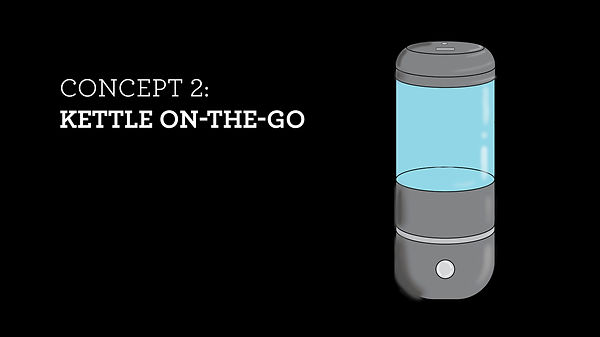


Design Development
The development process centred on challenging assumptions around the kettle, exploring:
-
portability vs. performance
-
usability vs. complexity
-
form vs. durability
Key guiding questions included:
-
Does the kettle need to remain static?
-
How can parts of the system travel with the user?
Through iterative sketching and prototyping, the design evolved into a dockable system that prioritises both flexibility and ease of use.


Design Development

Final Design
Three core considerations shaped the final direction:
-
Durability — able to withstand the “rough and tumble” of daily life
-
Intuitive use — not introducing unnecessary complexity
-
Reduced friction — simplifying preparation, heating, and cleaning
These principles ensured the product remained practical and accessible despite introducing a new typology.
User Experience
The interaction model is designed to feel familiar, despite introducing a new system.
The user journey is simple and intuitive:
-
Fill the vessel and secure the lid
-
Place the vessel into the dock
-
Activate and adjust temperature using a dial interface
-
Remove and take the beverage on the go
The use of:
-
tactile dial control
-
visual temperature feedback
-
minimal interaction steps
Ensures the system remains aligned with Breville’s existing product language while supporting a new use case.


A key technical challenge was integrating induction heating into a portable system.
To achieve this:
-
The heating element is housed in the dock
-
A heating interface is integrated into the base of the vessel
-
Insulated materials prevent heat transfer to external surfaces
Material choices align with Breville’s manufacturing approach:
-
High-temperature polymers for structural components
-
Brushed stainless steel for durability and aesthetic consistency
-
Food-safe polypropylene for user-contact elements
This ensures both performance and brand alignment.
Material & Technical Thinking

Product Ecosystem
Hot To Go extends beyond a single product into a modular ecosystem designed to support diverse users and contexts.
The system expands to include:
-
A baby bottle — supporting parents
-
A handled mug — improving accessibility for elderly users
-
A matcha bowl — responding to cultural and social trends
-
A larger bowl range — enabling food preparation on the go
This adaptability allows the product to respond to:
-
lifestyle diversity
-
mobility needs
-
emerging consumption trends


Commercial Opportunity
The ecosystem model creates new opportunities for Breville to:
-
expand into adjacent markets
-
diversify product offerings
-
collaborate with external brands
Potential partnerships (e.g. baby or lifestyle brands) enable further growth and integration into users’ daily routines.
Final Outcome
Hot To Go reframes the kettle as:
-
portable rather than static
-
adaptable rather than singular
-
system-based rather than product-based
The design balances:
-
technical feasibility
-
user-centred thinking
-
and commercial opportunity
to propose a new category of small domestic appliance.


Reflection
This project strengthened my ability to design beyond object-level outcomes, considering systems, user behaviour, and market opportunity simultaneously.
It reinforced the importance of:
-
challenging existing product archetypes
-
designing for evolving lifestyles
-
and aligning innovation with real-world viability
